Doc
Scala CLI can generate the API documentation of your Scala 2, Scala 3, and Java projects. It provides features similar
to javadoc.
The API documentation is generated in a directory whose files make up a static website:
package hello

/** Hello object for running main method
 */
object Hello {
  /**
   * Main method
   * @param args The command line arguments.
   * */
  def main(args: Array[String]): Unit =
    println("Hello")
}
scala-cli doc Hello.scala -o scala-doc
# Wrote Scaladoc to ./scala-doc
The output directory scala-doc contains the static site files with your documentation.
Cross-building documentation ⚡️
The --cross option is experimental and requires setting the --power option to be used.
You can pass it explicitly or set it globally by running:
scala-cli config power true
Use --cross (with --power) to build and generate Scaladoc for every Scala version and platform combination
configured for your project—the same behavior as run and package with --cross. This is useful when you have
multiple Scala versions or platforms and want documentation for each.
Example: a library that supports both Scala 2.13 and 3.3 LTS:
//> using scala 2.13 3.3.7
package lib

/** Example class for cross-built documentation. */
class Example {
  /** Returns a greeting. */
  def greet: String = "Hello"
}
When --cross produces multiple cross builds, the output directory is split into one subdirectory per combination: by
default a subdirectory per Scala version (e.g. doc-out/2.13.18, doc-out/3.3.7), and when targeting multiple
platforms, each subdirectory name includes the platform (e.g. doc-out/3.3.7_jvm). This avoids overwriting docs from
different builds.
scala-cli --power doc --cross . -o doc-out
# Wrote Scaladoc to doc-out/2.13.18
# Wrote Scaladoc to doc-out/3.3.7
Without --cross, only a single build (the default Scala version and platform) is documented and written to the given
output path.
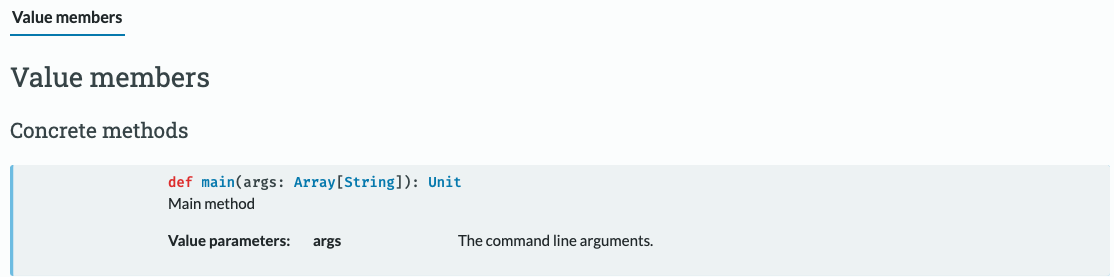
After opening the generated static documentation (you have to open scala-doc/index.html in your browser),
you will see the generated scaladoc documentation. The following screen shows the definition of the main method: